Since January 2024, the political scientist Jonas Pentzien is head of the research field “Business, value chains and consumption” at the Institute for Ecological Economy Research (IÖW) in Berlin. He heads the field together with the sustainable business researcher Dr. Christian Lautermann.
more
Since December 2023, the agricultural scientist and environmental economist Dr. Alexandra Dehnhardt is head of the research field ‘Ecological Economics and Environmental Policy’ at the Institute for Ecological Economic Research (IÖW) in Berlin. She jointly leads the research field together with the sustainability and transformation scientist Dr. Florian Kern.
more
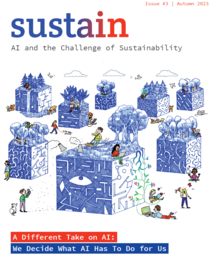
Who can take responsibility for steering problematic developments in AI back in the right direction? This is the question addressed in the third and final issue of the SustAIn magazine. Before the EU starts the final negotiations on the AI regulation on 6 December 2023, AlgorithmWatch, the IÖW and the DAI Lab at TU Berlin provide an up-to-date overview of the sustainability impacts of AI – from AI resource consumption through online marketing to the water footprint of AI systems. The project was funded by the German Federal Ministry for the Environment.
more
To strengthen economic and social cohesion within the European Union, the European Commission provides “cohesion funds”. These make up around a third of the EU budget. To date, the funds have mainly been used for roads, motorways and bridges in structurally weak regions. Since 2021, cohesion policy should also take much greater account of environmental goals, such as the Paris Climate Agreement. An Academic Sounding Board is now to help channel investments in a sustainable way. Florian Kern, research group leader at the IÖW, has been appointed to the board, which will meet for the second time on 22 November 2023.
more
Existing consumption and production systems, which use natural resources to meet societal needs for food, shelter, energy and health, are unsustainable. Although researchers from different disciplines have long investigated how these systems can become more sustainable, scientists from socio-technical and socio-environmental research communities are now seeking to join forces. A special feature in the Proceedings of the National Academy of Sciences, which was guest edited by researchers from the University of Manchester, the Institute for Ecological Economy Research, and Harvard University, presents new findings about transitions in electricity, food, and mobility systems.
more
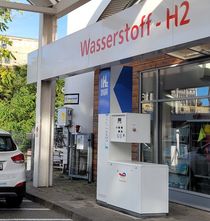
Which alternatives exist to replace coal, oil and natural gas? Hydrogen increasingly gains attention in connection with decarbonization internationally. In Germany, hydrogen has become a central component of climate protection policy and is seen by some players almost as a panacea for decarbonization. An article by IÖW authors analyzes the expectations of relevant stakeholders regarding the future development of the energy carrier. Conclusion of the researchers: A targeted political prioritization of hydrogen applications could defuse tensions and support a common vision.
more
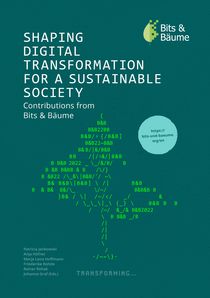
From artificial intelligence and the environmental impact of the digital economy to global justice: the digital transformation presents numerous challenges and risks. The book “Shaping Digital Transformation for a Sustainable Society”, which is being presented today by the Bits & Bäume network at the re:publica conference in Berlin, shows how society can become digitally sustainable.
more
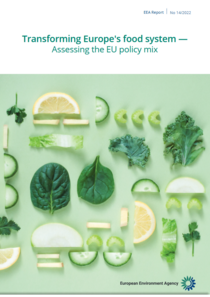
Conventional food production and consumption accounts for one third of greenhouse gas emissions worldwide. It contributes significantly to biodiversity loss and can be detrimental to human health. In many cases, it does not ensure fair economic returns and livelihoods for those involved in the industry. The European Commission has set out a programme for sustainable food systems with the ‘Farm to Fork Strategy’ as part of the European Green Deal, and set ambitious goals in developing an EU legislative framework for sustainable food systems this year. A new report from the European Environment Agency shows that this shift to sustainable food systems will require huge changes in the ways food is being produced and consumed.
more
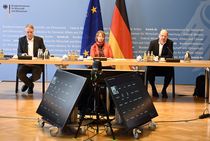
From 2000 to 2021, at least 145 billion euros in damages were caused by the consequences of heat, drought or floods. 80 billion of this since 2018 alone. These extreme weather events are becoming more likely due to climate change. By the middle of the century, researchers expect cumulative economic losses of 280 to 900 billion euros, depending on the extent of global warming. This is the result of a recent study presented today in Berlin. The study was carried out by the IÖW, the Gesellschaft für Wirtschaftliche Strukturforschung (GWS) and Prognos AG; it was commissioned by the BMWK and technically supported by the BMUV. In addition to the financially measurable damages, there are numerous health impairments, deaths from heat and flooding, the strain on ecosystems, the loss of biodiversity, and the reduction of quality of life.
more
Large fossil-fuel power plants still stabilize the power system in the event of fluctuations in the energy supply. But there are increasingly renewable replacements: More and more German households have their own photovoltaic system with battery storage. If these storage systems are virtually connected with each other using digital information and communication technologies (ICT), they can take over such stabilizing services for the energy system. The Institute for Ecological Economy Research (IÖW) has now conducted a detailed life cycle assessment to evaluate the environmental effects of such virtual pools. The conclusion: there are major benefits for climate protection and the environment as a whole.
more








![[Translate to Englisch:]](/fileadmin/_processed_/6/9/csm_PNAS_Transitions_SF_Cover_5327184149.png "[Translate to Englisch:]")