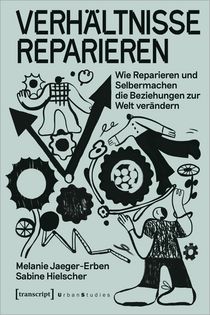
Repairing is in vogue. While new Repair Cafés are opening every week, the "Screw loose!?" initiative is making inroads into the European Union with its demand for a right to repair. Is this the renaissance of a cultural technique that was thought to have been lost, or merely a short-lived hype? In the book "Verhältnisse Reparieren," researchers Melanie Jaeger-Erben and Sabine Hielscher delve into the world of amateur repair and do-it-yourself. Above all, the two authors are concerned with one thing: describing how repairing and DIY can have a positive impact on identity and also improve social relationships and the troubled relationship between people and the environment.
more
„Die Bits dürfen uns nicht die Bäume kosten.“ Diese Forderung brachte am vergangenen Wochenende über 2.500 Teilnehmende zur Konferenz für Digitalisierung und Nachhaltigkeit „Bits & Bäume“ nach Berlin. Auf Einladung von 13 Organisationen aus Umwelt,- Klima- und Naturschutz, Digitalpolitik, Entwicklungszusammenarbeit und Wissenschaft, darunter das IÖW, trafen sich Wissenschaftler*innen, Aktivist*innen und Politiker*innen, um politische Forderungen und Handlungsansätze für eine nachhaltige Digitalisierung zu diskutieren. In Zeiten von Klima-, Energie- und staatlicher Vertrauenskrise müssten digitale Technologien vor allem dem sozial-ökologischen Wandel dienen, anstatt durch explodierenden Energiebedarf und Ressourcenverbrauch und immer mehr Überwachung die Krisen weiter anzuheizen, so der Appell der Konferenz.
more
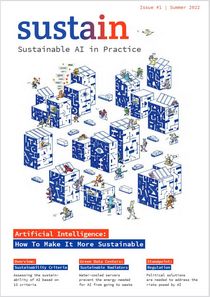
Overheated data centers, massive CO2 emissions generated by large language models, extraction of natural resources and automated inequality: It sounds like AI will contribute to the planet’s demise, rather than save it. But all the talk about the sustainability of AI so far has remained largely theoretical and imprecise. In the midst of a climate crisis, where everything is on the line, the discussion deserves more accuracy, scrutiny, and evidence. There are ways to make AI more sustainable, reduce its resource consumption, include affected communities in its development, and respect people’s autonomy. The SustAIn Magazine from Algorithmwatch, IÖW and DAI-Labor of TU Berlin gets real and cuts right to the chase. It includes interviews with experts in the field of sustainable AI and practical examples that are already making a difference.
more
In his opening statement, Federal Minister of Economics Robert Habeck made it clear that new instruments are needed to expand renewable energies more quickly and achieve Germany's climate goals. The Bündnis Bürgerenergie has provided a proposal with its energy-sharing concept. The Institute for Ecological Economy Research (IÖW) has now investigated the potential of involving citizens in the energy transition through energy sharing. According to the IÖW study, there are suitable locations throughout Germany, so that more than 90 percent of people could join together in "renewable energy communities."
more
If the climate targets are to be achieved, a different way of doing business is essential. The European Commission now also sees this and the circular economy has become a key element in the European Green Deal and for the transformation of current production and consumption patterns. In the new issue of ÖkologischesWirtschaften, the authors provide different perspectives on the circular economy and ask whether the circular economy can really be seen as a solution for decoupling growth from resource consumption.
more
The Platform Cooperativism Consortium (PCC), the Institute for Ecological Economy Research (IÖW), and the WZB Berlin Social Science Center host the annual PCC conference #TheNewCommonSense – Forging the Cooperative Digital Economy from November 12 to 18, 2021. The conference brings together more than 80 scholars and practitioners from over twenty countries for a two-day in-person event at Humboldt University of Berlin on November 12 and 13. The conference concludes with a series of online sessions from November 15 to 18.
more
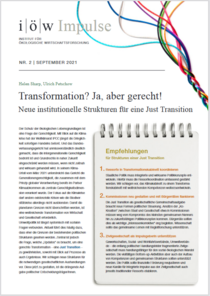
It is becoming increasingly clear that environmental and climate protection and social justice are two sides of the same coin and can only be advanced together. In order to usher in the necessary substantive steps, new institutional structures are needed to consolidate interministerial cooperation, particularly between the environmental and social policy ministries, the Institute for Ecological Economy Research (IÖW) and the Open Society Foundations recommend in a policy briefing published on September 2, 2021. They advise policymakers to develop the climate cabinet into a comprehensive transformation cabinet in which social policy actors are also included which is currently not the case. This cabinet should receive advice from citizens' councils and societal commissions including interest groups, policy makers as well as civil society organizations. Trade unions, social, welfare and environmental organizations should also initiate overarching processes of communication, capacity building and working together. In this way, the just transition – a socially just ecological transformation of the economy and society – can succeed.
more
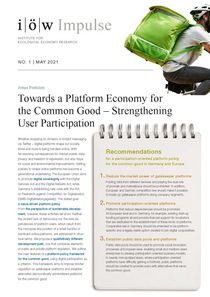
From Amazon to Zalando, online platforms are shaping our society. Corona has given a further boost to many digital corporations. Shaping and regulating the platform economy politically is a generational task. Based on current research, the Institute for Ecological Economy Research (IÖW) recommends that Germany and the European Union should focus more on the common good and user participation in platform policy. The market power of a few dominant monopoly-like platforms must be reduced. Democratically constituted platform alternatives should be strengthened so that users can become more independent and participate more. And the public sector should create its own offerings in critical areas as a service of general interest.
more
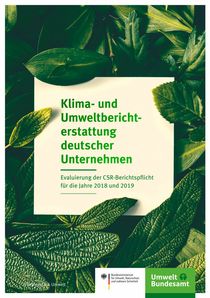
Certain large enterprises in the European Union are required to publicly disclose sustainability information. In this way, especially financial market participants shall obtain a more comprehensive picture of the sustainability risks enterprises are exposed to and of the impacts they have on environment and society. A recent study by the German Environment Agency (UBA), carried out by the Institute for Ecological Economy Research (IÖW) together with the management consultancy Arqum and the Fair Finance Institute, shows that even though German companies increasingly report on climate, water, resources and waste, significant gaps remain. Only about 20 percent disclose information on air pollution and biodiversity. Apparently, the identified gaps in corporate reporting are often due to insufficient legal provisions. UBA suggests, among others, to require more detailed reporting on individual environmental topics at EU level.
more
Communities or individual citizens producing, using and selling their own renewable energy could provide up to 89 percent of the electricity demanded in the residential sector by 2050. The European research project PROSEU carried out in cooperation with the IÖW has concluded that, in the coming years, European, national and local governments have a unique chance to support ‘prosumerism’ and thus an effective and socially just energy transition.
more